

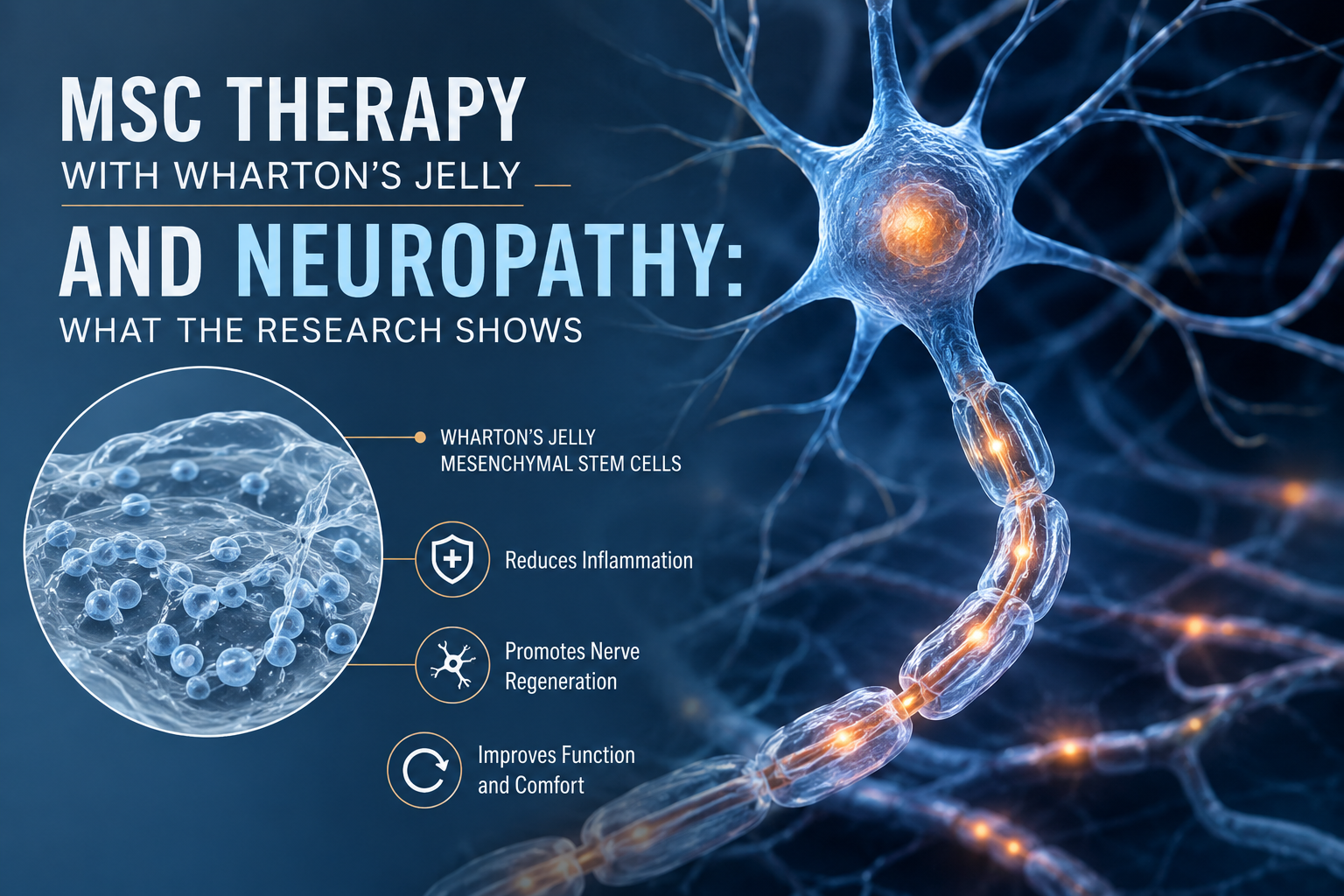
MSC Therapy for neuropathy: what the research shows.
Neuropathy — the burning, tingling, numbness, or shooting pain that comes from irritated or damaged nerves — is one of the most frustrating conditions to live with, partly because standard options often manage symptoms rather than address the nerves themselves. If you’ve been searching for alternatives, you’ve likely come across mesenchymal stromal cell (MSC) therapy. This article looks honestly at what the research actually shows so far, and, just as importantly, what it doesn’t.
A quick refresher on MSCs
Mesenchymal stromal cells, or MSCs, are a type of cell found naturally in the body. Scientific interest in them centers less on the idea that they “become” new nerves and more on the signaling molecules they release. In laboratory and animal studies, MSCs appear to participate in the body’s normal processes of regulating inflammation and supporting the local environment around tissue. MSCs used in research come from several sources, including bone marrow, fat, and umbilical cord tissue such as Wharton’s Jelly. Because nerve-related discomfort often involves inflammation and blood-flow factors, researchers have asked whether MSCs’ signaling role might be relevant to how the body maintains nerve tissue. Importantly, “relevant to research questions” is not the same as “shown to help,” and the sections below explain why that distinction matters so much here.
What the studies actually report
Here’s where honesty matters. There is a real and growing body of research on MSCs and peripheral neuropathy, especially diabetic peripheral neuropathy, but it is still early.
A 2024 systematic review and meta-analysis pulled together the controlled human trials available at the time. It found only about seven such trials, involving roughly 400 patients in total, most conducted in a single region of the world. Across those studies, researchers measured objective markers such as nerve conduction velocity and vibration perception, along with clinical symptom scores. The pooled results pointed in a favorable direction on several of these measures, and the reported side effects were generally minor and short-lived — typically pain or swelling at the injection site that resolved within days.
That sounds encouraging, and it is worth taking seriously. But the same reviewers were careful to describe the evidence as promising but preliminary. The trials were small. Follow-up periods were short, so little is known about how long any measured changes last. Study designs and cell-preparation methods varied, making it hard to compare results directly. And larger, longer, independently replicated trials — the kind that regulators and cautious clinicians look for before drawing firm conclusions — are still underway rather than complete.
Why “what the research shows” is not the same as “what it proves”
It’s easy to read a positive study summary and hear “this works.” A more accurate reading is: early research has observed changes worth investigating further, under specific conditions, in specific groups of people. Measuring an improvement in a nerve-conduction number in a small trial is a meaningful scientific signal. It is not the same as a proven, predictable outcome for an individual living with neuropathy at home. Different types of neuropathy — diabetic, chemotherapy-related, injury-related, and others — also have different underlying causes, and evidence from one does not automatically transfer to another.
Where things stand with regulation and access
In the United States, MSC preparations are not FDA-approved as a treatment for neuropathy or any related condition. Much of the human research to date has taken place through clinical trials, some outside the U.S. The FDA has also issued public advisories cautioning consumers about clinics marketing unproven cell-based products with strong promises. None of this means the science is illegitimate; it means the field is still in the research stage, and marketing claims frequently run ahead of the evidence. Anyone weighing these options should be especially skeptical of any provider guaranteeing results, quoting dramatic success rates, or describing an unproven procedure as an established cure.
Questions worth asking
If you’re exploring this area, useful questions for any clinician include: Is this being offered as part of a registered clinical trial? What specific type of neuropathy has actually been studied, and does it match mine? What does the provider claim, and can they show published, peer-reviewed evidence rather than testimonials? And how does this fit alongside — not instead of — the care I already receive for the underlying cause of my neuropathy, such as blood-sugar management? Bringing these questions to your own healthcare team helps you weigh the trade-offs realistically.
Questions?
Vivonyx’s goal is to help you understand emerging areas like this one clearly, without hype in either direction. The research on MSCs and neuropathy is genuinely interesting and genuinely unfinished, and both halves of that sentence deserve attention. If you have questions about anything covered here, or you’d like help making sense of a study or a claim you’ve encountered, reach us any time at hello@vivonyx.com.

What is Wharton's Jelly MSC Therapy — and How is it Different From PRP?
If you're living with chronic joint pain or nerve discomfort, you've probably run into a wall of unfamiliar terms while researching your options: PRP, stem cells, MSCs, "regenerative medicine." Two of the names that come up most often are Wharton's Jelly-derived MSCs and PRP. They're frequently mentioned in the same breath, but they are not the same thing. This guide walks through what each one actually is, in plain language, so you can ask sharper questions and set realistic expectations.
What are Wharton's Jelly-derived MSCs?
Mesenchymal stromal cells — usually shortened to MSCs — are a type of cell your body already contains. Researchers are interested in them largely because of the signaling molecules they release, which appear to play a role in the body's normal processes of managing inflammation and supporting tissue maintenance. MSCs can be gathered from several places, and the source matters.
Wharton's Jelly is the soft, gel-like connective tissue inside the umbilical cord that cushions the cord's blood vessels. It happens to be unusually rich in MSCs. "Wharton's Jelly-derived MSCs," then, simply means mesenchymal cells collected from that specific tissue rather than from an adult donor's bone marrow or fat.
Where do they come from?
These cells come from umbilical cord tissue that is donated after a healthy, full-term birth — material that would otherwise be discarded. Donation follows informed consent and screening processes similar to those used for other donated human tissue. Because the cord is collected at birth, the donor is neither the mother nor the patient receiving any preparation later. This is worth understanding up front, since people sometimes assume "stem cells" means embryonic cells; Wharton's Jelly MSCs are not embryonic and are not derived from a fetus.
Why "Day 0" cells matter
You'll sometimes see the phrase "Day 0" cells. It refers to how much laboratory handling a cell preparation has been through. When cells are grown and multiplied in a lab over days or weeks — a process called culturing or passaging — they age in a biological sense and can gradually lose some of their original characteristics. "Day 0" describes cells that are processed and used without that extended expansion. The idea behind emphasizing this is straightforward: cells sourced from birth tissue start out young, and minimal culturing is meant to keep them closer to that starting state. It's a reasonable structural distinction to understand, though, as noted below, it is not a promise of any particular result.
How does this compare to PRP?
PRP, or platelet-rich plasma, is a very different starting material. It's made from your own blood. A sample is drawn and spun in a centrifuge to concentrate the platelets, which carry growth factors involved in the body's normal healing signaling. That concentrate is then used at the treatment site.
The key difference is that PRP is not a cell therapy in the way MSC preparations are. It contains your platelets and plasma, not a population of mesenchymal cells. Its main appeal is that it's autologous — it comes from you — so questions about donor matching don't apply, and it's a comparatively simple, well-established procedure. Wharton's Jelly preparations, by contrast, come from donated tissue and are studied for a different set of properties. Neither is a stronger-or-weaker version of the other; they're distinct tools built on different biology.
How does this compare to bone marrow?
Bone marrow is another common MSC source. Here the cells are drawn from the patient's own hip bone through a needle procedure, which is more invasive than a blood draw and can be uncomfortable. Bone marrow MSCs are also adult cells, meaning their biological age reflects the donor's age. Laboratory research has generally found that Wharton's Jelly MSCs multiply more readily and reach a mature, aged state more slowly in culture than adult bone marrow cells — one reason birth-tissue sources draw scientific interest. The trade-off is that bone marrow is autologous, while Wharton's Jelly is donor-derived.
Where the research is still evolving
Honesty matters most here. Wharton's Jelly MSCs are an active and genuinely promising area of research, but the science is still developing, and important questions remain open. There is meaningful donor-to-donor variation between tissue samples, long-term data is still being gathered, and independent testing has shown that some commercially marketed umbilical cord and Wharton's Jelly products contain far fewer viable cells than their labels suggest. In the United States, these preparations are not FDA-approved to treat any disease or condition, and the FDA has issued public advisories about unproven cell-based products. That doesn't mean the field is meaningless — it means claims of guaranteed outcomes should be treated with skepticism, and anyone considering these options deserves clear, verifiable information from their provider.
Questions?
Vivonyx exists to help you make sense of this fast-moving field without hype. If you have questions about anything in this article, or you'd like help thinking through what to ask a provider, reach us any time at hello@vivonyx.com. We're happy to point you toward reliable, balanced information.
Educational disclaimer: This article is for general educational purposes only and does not constitute medical advice, diagnosis, or treatment. It is not intended to describe or suggest the treatment, cure, or prevention of any disease or condition. Cellular preparations discussed here are not FDA-approved therapies. Always consult a qualified, licensed healthcare professional before making any medical decision. Individual circumstances vary, and no specific outcome is implied or guaranteed.