

By Vivonyx · Last reviewed: October 2026
In 2016, two researchers went looking for U.S. businesses advertising stem cell treatments directly to the public. They found 351 companies selling at 570 clinics [1]. That count is from 2016, but the point still stands: there are a lot of options, and they're not all the same thing.
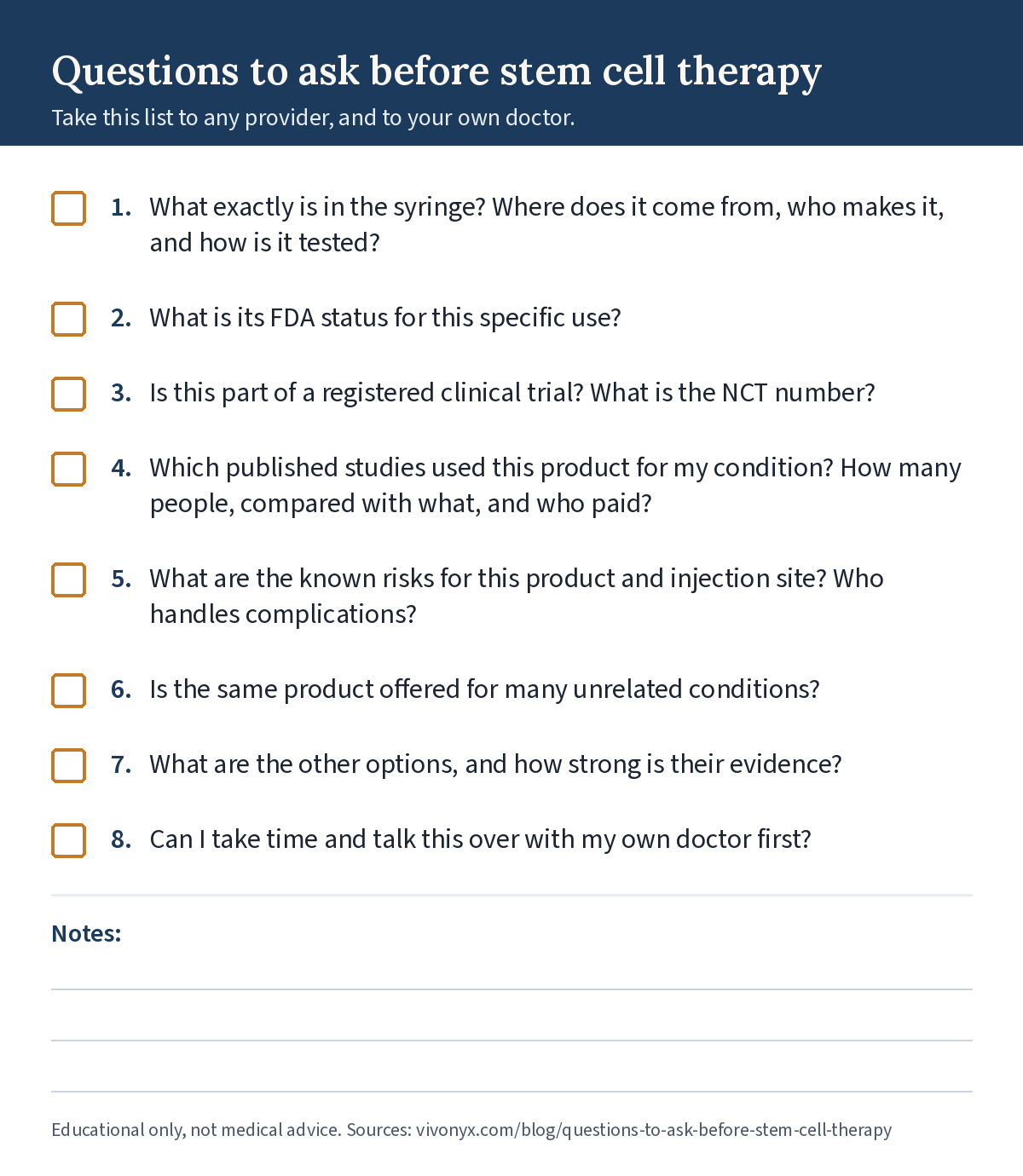
The good news is that you don't need a biology degree to sort through them. You need good questions. Here are eight that people researching regenerative medicine may want to ask any provider, and what the research says about why each one matters. This isn't medical advice, just a starting list.
1. What exactly is in the syringe?
"Stem cell therapy" can mean cells from your own bone marrow or fat, cells grown from donated umbilical cord tissue (including Wharton's jelly), platelet-rich plasma (no stem cells at all), or exosomes (no living cells). Ask where the product comes from, who makes it, and what testing shows about what's actually in it. These are different products, and a study of one doesn't automatically apply to another [2]. If the terms are new, our Start Here page explains them in two minutes.
2. What is its FDA status for this use?
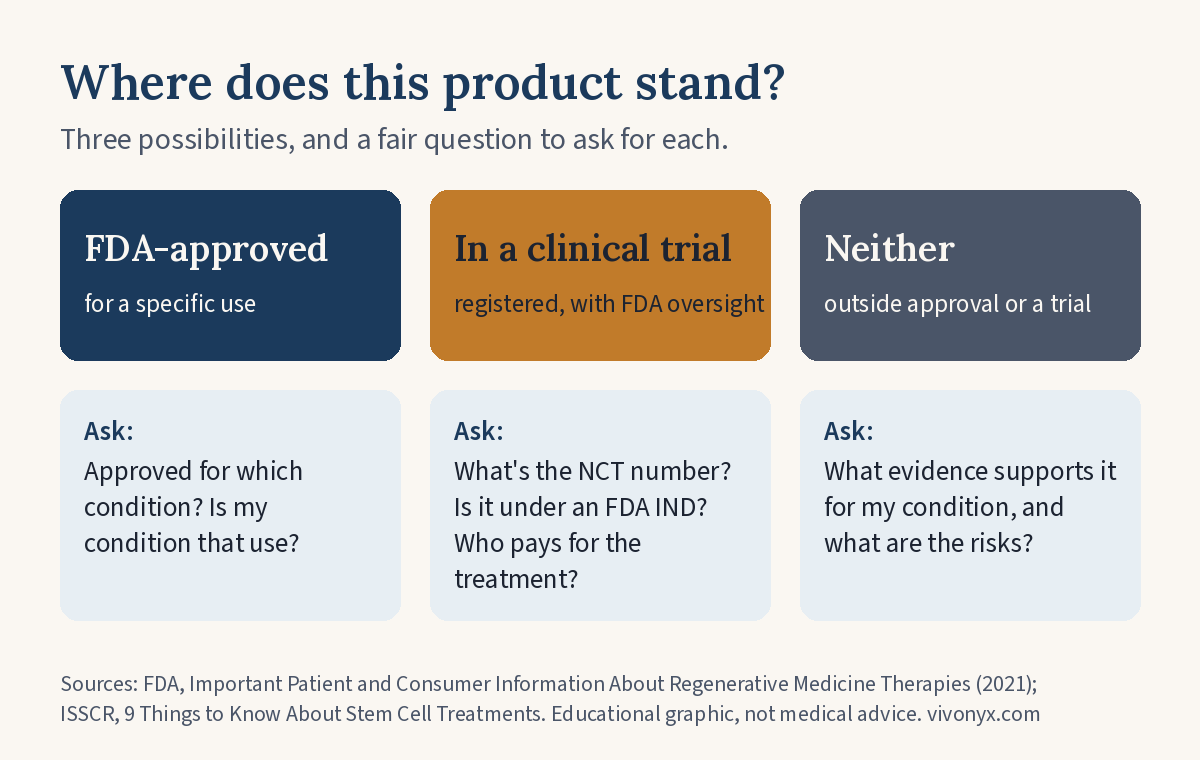
"FDA-approved" is specific: a product, for a use. The FDA has approved a small number of stem cell products, such as cord blood cells for blood disorders and, in 2024, one MSC product for a serious transplant complication in children [3][4]. It says regenerative medicine products haven't been approved for orthopedic conditions like osteoarthritis, back pain, or knee pain, and that they need FDA oversight in a clinical trial before approval [3]. Asking "approved for what?" is a fair, neutral question.
3. Is this part of a clinical trial, and can I see the record?
Real trials are registered and have an ID number that starts with "NCT", which you can look up on ClinicalTrials.gov. But a listing alone doesn't tell you much. The FDA notes that being in that database, or having a company "registered" with FDA, doesn't mean a product is legally marketed [3]. One researcher found businesses listing "pay-to-participate" studies there [5]. The International Society for Stem Cell Research says responsible trials don't charge participants for the experimental treatment [2].
4. Which published studies used this product for my condition?
Ask for the studies, not the brochure. Then look at size, comparison group, and who paid. For knee osteoarthritis, for example, a 2025 Cochrane review of 25 trials found stem cell injections may slightly improve pain, by about 1.2 points on a 0-to-10 scale, with low-certainty evidence [6]. A 480-person trial found three cell products did no better than a steroid shot at one year [7]. That's real data, and it's more modest than most ads. More in our knee research tour.
Get the next article in your inbox
One short email when a new research article goes up. No spam, unsubscribe anytime.
5. What are the risks, and what happens if something goes wrong?
In the 480-person trial above, no serious problems were linked to the injection procedure [7]. But the setting matters. Eye doctors have described three people who lost most or all of their vision after a U.S. clinic injected fat-derived "stem cells" into their eyes [8]. The FDA lists reported harms from unapproved products, including infections, blindness, and tumor formation [3]. Ask what the known risks are for this product and this injection site, and who handles complications.
6. Is the same product offered for lots of unrelated conditions?
Cells from one tissue have limited jobs. The ISSCR cautions that one cell treatment working for a wide range of unrelated diseases is very unlikely, and that claims cells will "know where to go" deserve skepticism [2].
7. What are the other options, and how strong is their evidence?
Every decision is a comparison. For knee osteoarthritis, the American College of Rheumatology strongly recommends exercise and, for people with overweight, weight loss [9]. Ask how a regenerative option stacks up against the best-studied alternatives for your situation.
8. Can I take this list to my own doctor first?
The ISSCR suggests discussing what you've learned with your own healthcare team before deciding [2]. A good provider won't mind you taking time. Testimonials aren't evidence: people can feel better for many reasons, which is why controlled trials exist [2].
FAQ
Is stem cell therapy FDA-approved?
Some specific products are, for specific uses: cord blood cells for certain blood disorders and one MSC product for a transplant complication in children [3][4]. None are approved for orthopedic conditions [3].
What's an NCT number?
The ID of a study registered on ClinicalTrials.gov. It lets you read the study's design and sponsor. A listing doesn't on its own mean a product is approved or legally marketed [3].
Are cells from my own body automatically safe?
Not automatically. Cells can be contaminated or changed during processing, and where they're injected matters [2].
Still have questions?
If you'd like to talk through what you've read or what to ask next, email hello@vivonyx.com. Or ask the Vivonyx AI assistant any time. You'll get a straight answer, including "the research doesn't know yet" when that's the truth. For background, see The Science and How We Research.
Related reading
Educational disclaimer: This article is for general education only and is not medical advice, diagnosis, or treatment. It does not describe a way to treat, cure, or prevent any disease or condition. Many products discussed are not FDA-approved for these uses. Talk with a licensed healthcare professional before making any medical decision. Full disclaimer
References
Turner L, Knoepfler P. Selling stem cells in the USA: assessing the direct-to-consumer industry. Cell Stem Cell. 2016;19(2):154-157. https://pubmed.ncbi.nlm.nih.gov/27374789/
International Society for Stem Cell Research. 9 Things to Know About Stem Cell Treatments. A Closer Look at Stem Cells. https://www.closerlookatstemcells.org/stem-cells-medicine/nine-things-to-know-about-stem-cell-treatments/
U.S. Food and Drug Administration. Important Patient and Consumer Information About Regenerative Medicine Therapies (June 3, 2021). https://www.fda.gov/vaccines-blood-biologics/consumers-biologics/important-patient-and-consumer-information-about-regenerative-medicine-therapies
U.S. Food and Drug Administration. FDA Approves First Mesenchymal Stromal Cell Therapy to Treat Steroid-refractory Acute Graft-versus-host Disease (Dec 18, 2024). https://www.fda.gov/news-events/press-announcements/fda-approves-first-mesenchymal-stromal-cell-therapy-treat-steroid-refractory-acute-graft-versus-host
Turner L. ClinicalTrials.gov, stem cells and 'pay-to-participate' clinical studies. Regen Med. 2017;12(6):705-719. https://pubmed.ncbi.nlm.nih.gov/28721755/
Whittle SL, Johnston RV, McDonald S, et al. Stem cell injections for osteoarthritis of the knee. Cochrane Database Syst Rev. 2025;4:CD013342. https://pubmed.ncbi.nlm.nih.gov/40169165/
Mautner K, Gottschalk M, Boden SD, et al. Cell-based versus corticosteroid injections for knee pain in osteoarthritis: a randomized phase 3 trial. Nat Med. 2023;29(12):3120-3126. https://pubmed.ncbi.nlm.nih.gov/37919438/
Kuriyan AE, Albini TA, Townsend JH, et al. Vision loss after intravitreal injection of autologous "stem cells" for AMD. N Engl J Med. 2017;376(11):1047-1053. https://pubmed.ncbi.nlm.nih.gov/28296617/
Kolasinski SL, Neogi T, Hochberg MC, et al. 2019 American College of Rheumatology/Arthritis Foundation guideline for the management of osteoarthritis of the hand, hip, and knee. Arthritis Care Res. 2020;72(2):149-162. https://pubmed.ncbi.nlm.nih.gov/31908149/